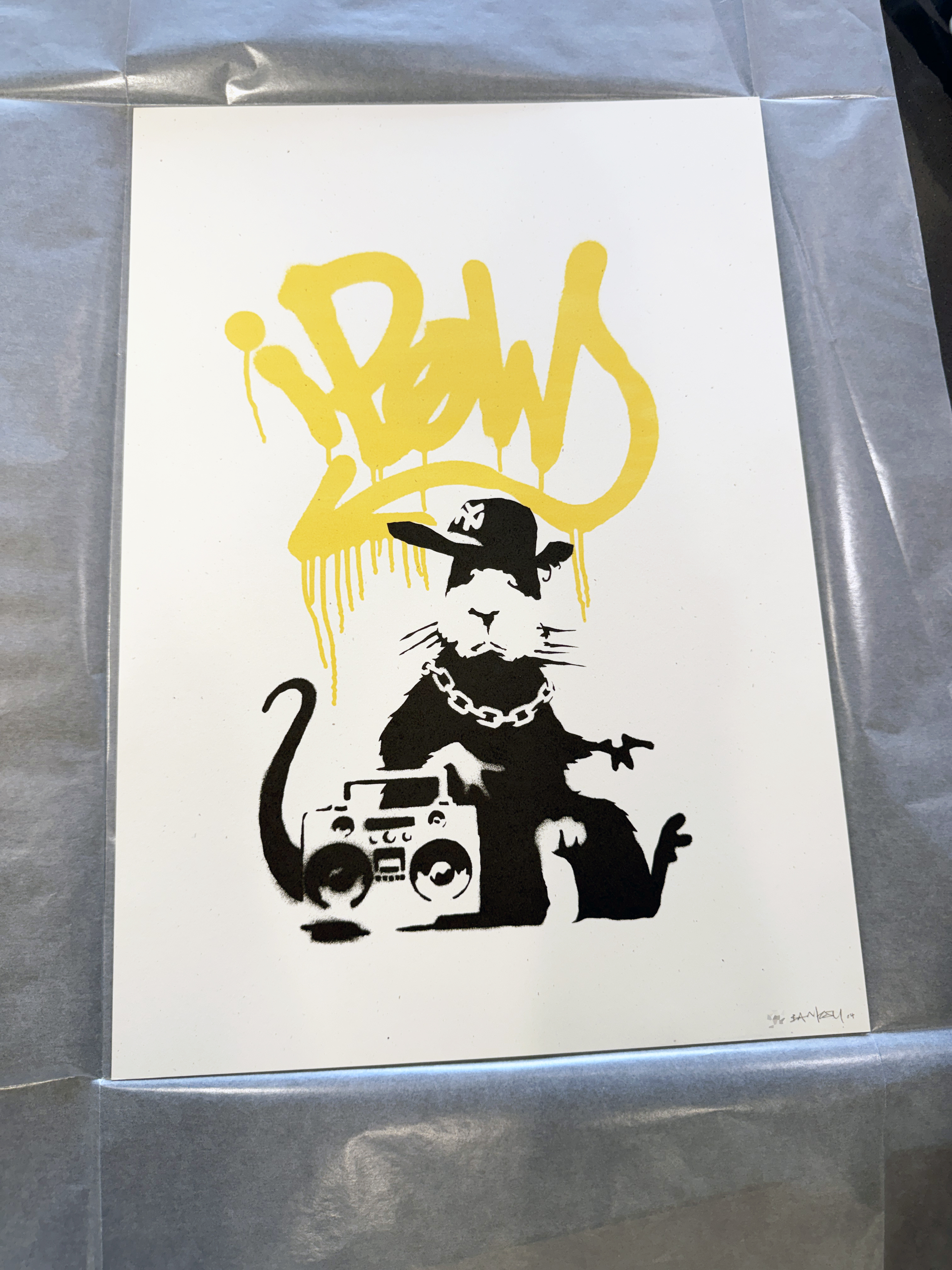
In 2018 a framed Girl with Balloon sold at auction for about $1.4 million, and the moment the hammer fell it slid halfway through a shredder Banksy had built into the frame. Renamed Love Is in the Bin, the shredded version came back three years later and sold for roughly $25 million. That stunt tells you everything about how this market works. The image is famous, endlessly reproduced, and almost beside the point. What gives a Banksy value is proof that Banksy stands behind it.
I'll make this concrete, because I recently placed one. The piece above is Gangsta Rat in the yellow colourway, a signed artist's proof from 2004, and it's one of only 10 known in yellow anywhere in the world. That is the kind of rarity that actually moves the needle, and I'm using it here as the worked example: the signed sheet, the certificate, the front and the back, and the way it left my hands. This is what real looks like.
With Banksy, the certificate is the asset
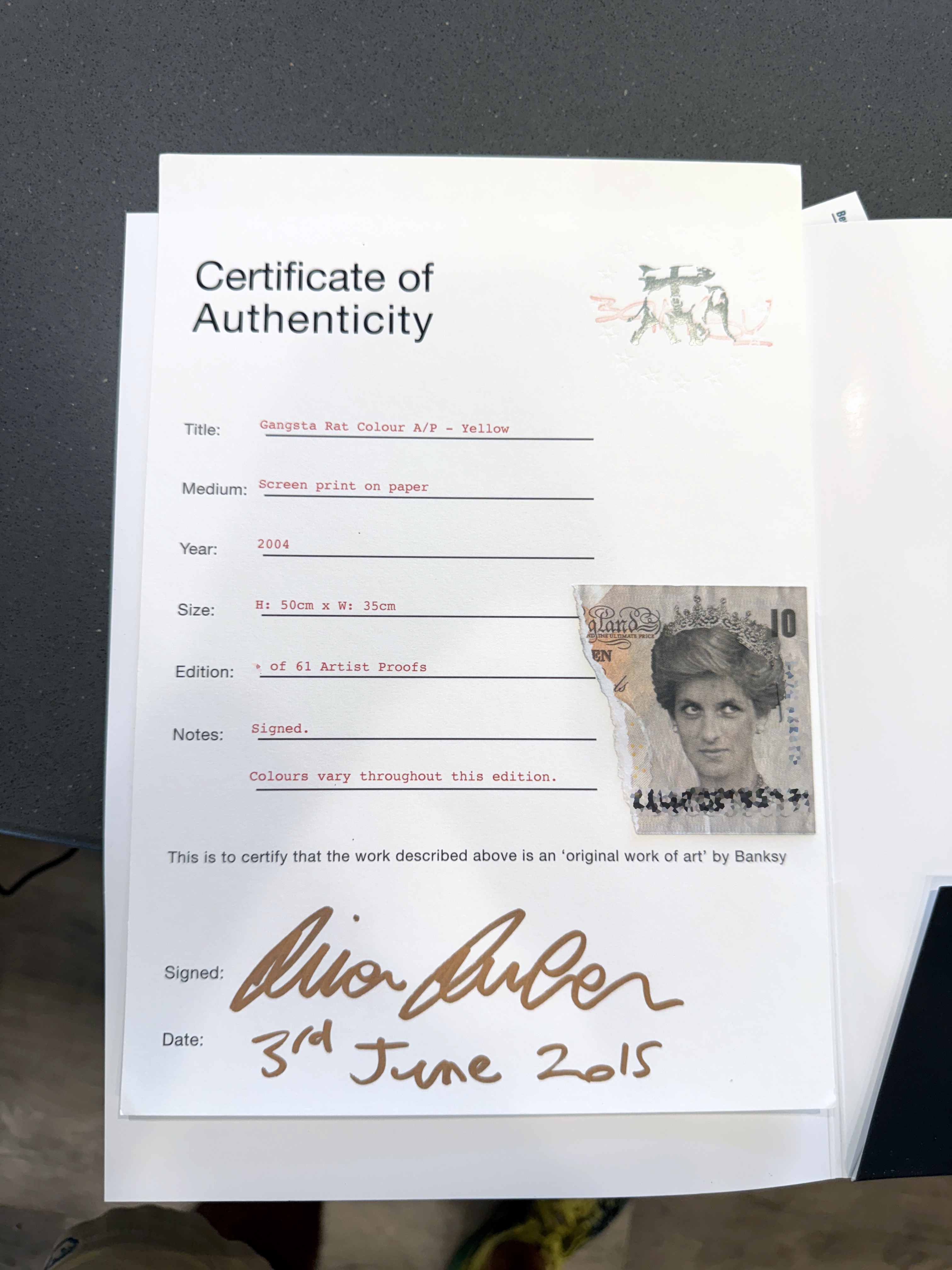
The Pest Control certificate for the Gangsta Rat. Serial redacted to protect the buyer.
There is exactly one body that can authenticate a Banksy, and it isn't a gallery, an auction specialist, or a dealer. It's Pest Control, the handling service Banksy set up for precisely this purpose. No one else's opinion counts, including mine. If a seller tells you a piece is "authenticated by" anyone other than Pest Control, that is not authentication. It's marketing.
Above is the actual certificate that came with the Gangsta Rat. Look at what makes it real. There's half of a "Di-faced tenner," the mock £10 note with Princess Diana's face where the Queen should be, torn in two, carrying a handwritten serial number that I've redacted here to protect the buyer. Pest Control keeps the matching half on file. There's the embossed Pest Control rat, the title and medium, the edition line, and the plain statement that this is "an original work of art by Banksy." Note also that the work is from 2004 while this certificate is dated 2015. That gap is completely normal. Owners often send a piece in to be authenticated years after they bought it. Treat the certificate as the asset and the artwork as the thing attached to it, not the other way around. Applying is an online process, it costs around $80 and only if the piece is accepted, and the queue runs from weeks to, in a backlog, years.
Pest Control authenticates the market, not the street
Here's where a lot of money gets lost. Pest Control certifies work Banksy made for commercial sale: the screenprint editions and the original works produced to be sold. It does not, as a rule, authenticate street pieces, the stencils sprayed on a wall, a door, a shutter. There are rare exceptions, but you should assume the answer is no.
So when someone offers you a "genuine Banksy" chiseled off a wall or lifted from a building site, understand what you're being offered: an object that the only authority in the world will almost certainly never certify. It may even be real. It is still, for market purposes, close to unsellable, because you can never hand the next buyer the one document they'll demand. Romantic story, terrible asset.
Signed versus unsigned is the biggest number in the room
First, the ceiling, so you know the range we're talking about. At the top, Banksy originals have made serious money: Devolved Parliament hammered at roughly $12 million in 2019, and Love Is in the Bin, the shredded one, resold for about $25 million. Those are the headlines. They are not where you'll be buying.
Where most collectors actually buy is prints, and the single biggest price lever there is whether Banksy signed it. Across 2025 and 2026, signed prints averaged roughly $60,000 at the hammer. Unsigned examples of the same images averaged closer to $20,000. That is about three times the price for a pencil signature on otherwise identical paper.
The Gangsta Rat above is a signed artist's proof, one of 61, and in yellow one of only 10 in existence, with Banksy's pencil signature at the lower right of the sheet. Scarcity like that is exactly what separates a good buy from a great one. At the top of the print market, signed editions of the images everyone knows, Girl with Balloon, the Flower Thrower, Choose Your Weapon, the Kate Moss set, run from about $75,000 into the mid six figures depending on the variant and condition. Unsigned versions of those same images trade actively in the $20,000 to $75,000 range. Here is the part people miss: unsigned does not mean unauthenticated. Both signed and unsigned editions go through Pest Control and both come with the certificate. The signature is a value multiplier, not a validity test. Decide which one you're buying, and never let a seller blur the two to justify a signed-level price on an unsigned sheet.
What I actually hand a buyer
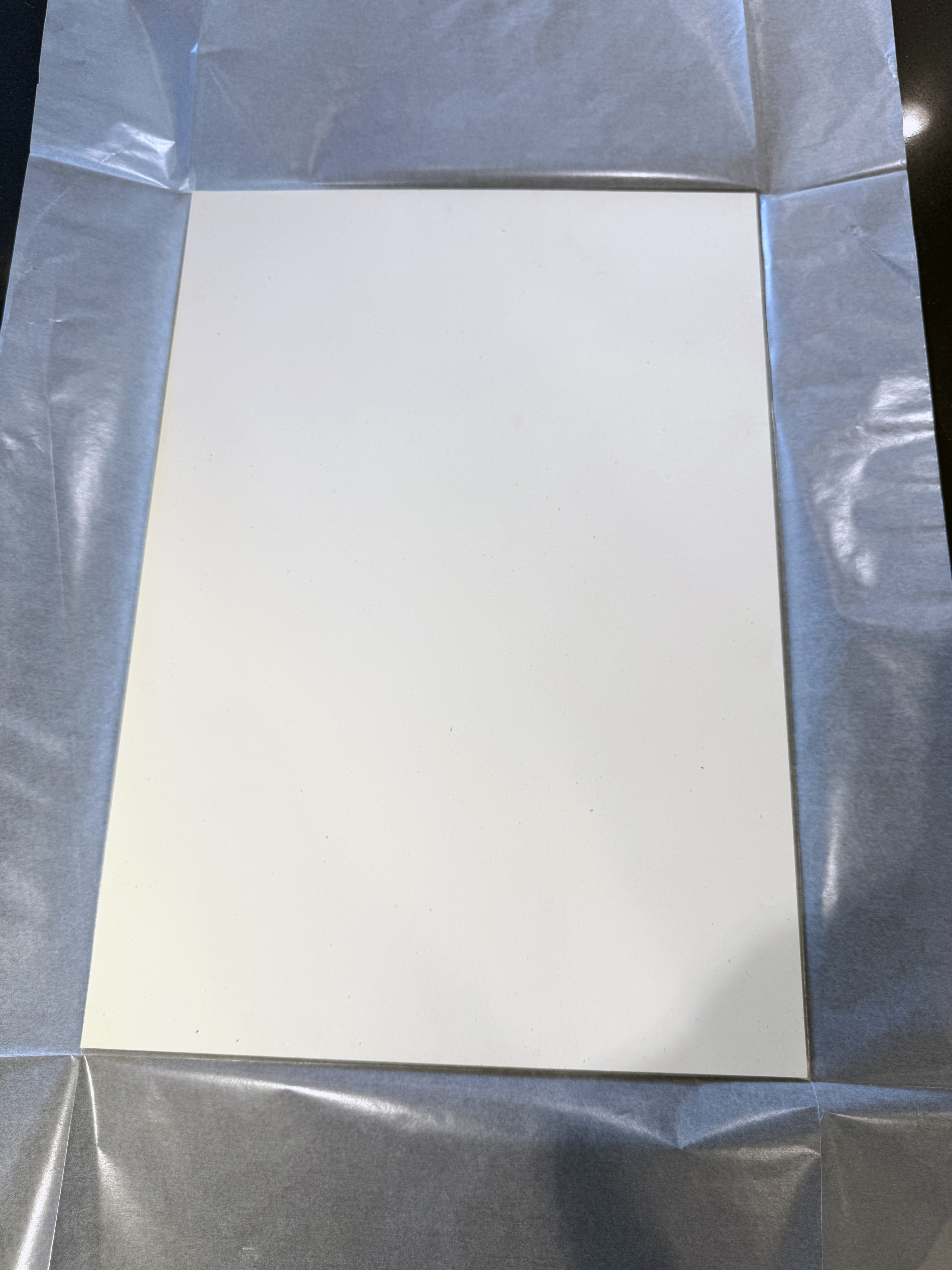
Verso: clean, unmounted, as it should be.
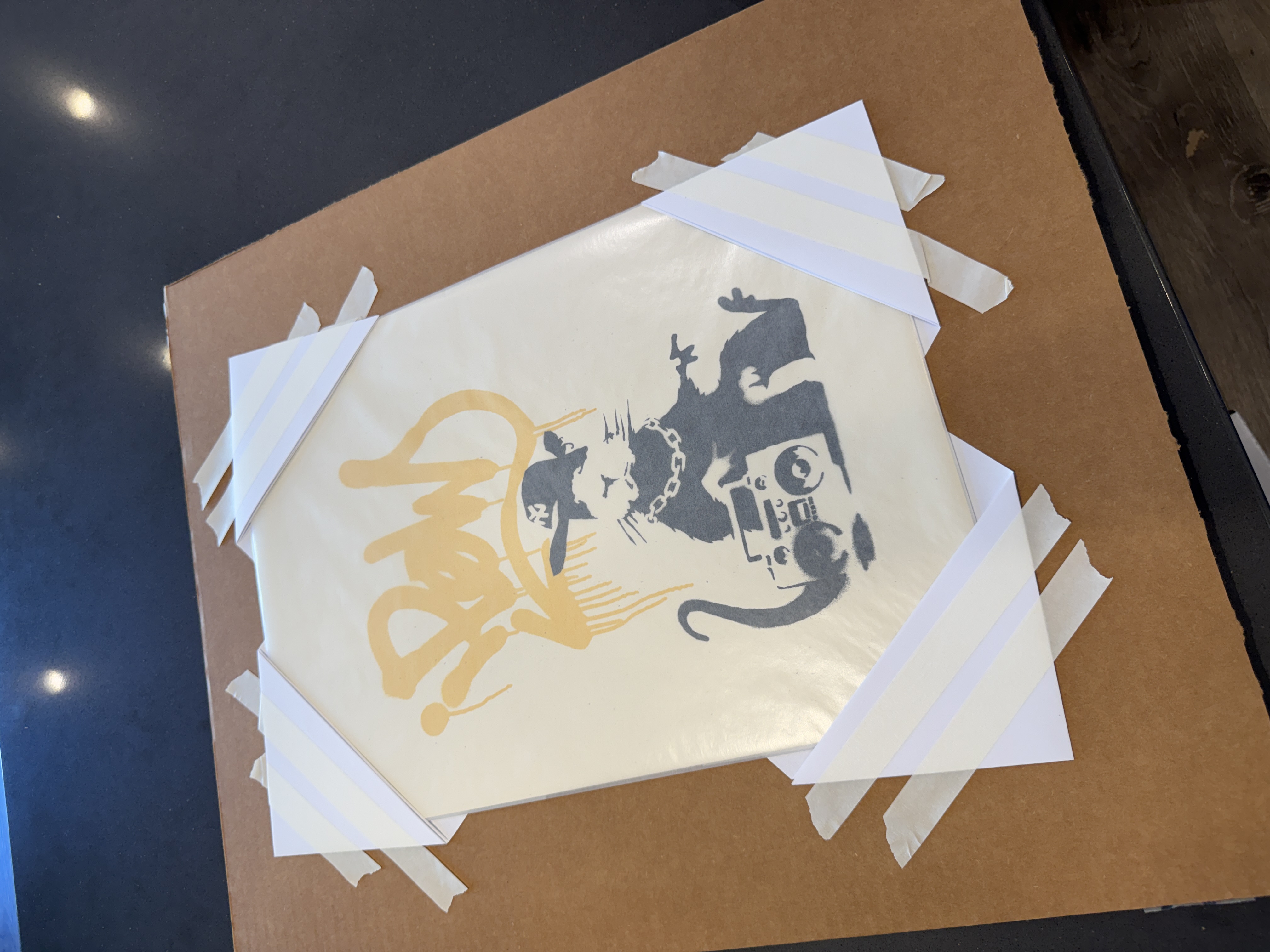
Secured in glassine and cradled for insured transit.
Diligence is not just the front of the sheet. I document recto and verso, because the back tells you about the paper stock, the condition, any foxing or handling, and whether the sheet has been glued down or mounted, which quietly damages value. The Gangsta Rat's verso is clean, unmounted, exactly as it should be. The certificate line "colours vary throughout this edition" matches the sheet, another small consistency you confirm rather than assume.
Then it ships like the second image: secured between glassine and a rigid backing board with archival corners, flat, and fully insured in transit. None of this is glamorous. All of it is the difference between an asset that holds its value and one that quietly loses it. When you buy through me, this is the standard, and when you buy through anyone, it's the standard you should insist on.
How the fakes actually get you
The forgeries are better than you think, and they rarely fail on the artwork. They fail on the paper around it. In 2024, Spanish police broke up a ring that had sold at least 25 fake Banksys across Europe and the US for up to about $1,600 each. The works were spray and stencil on cardboard, dressed up with ink stamps and stickers. What made them sell was the documentation: forged certificates, and photocopied Dismaland ticket receipts staged to look like provenance. Pest Control later confirmed both the works and their certificates were fake.
The lesson is blunt. A certificate you can hold in your hand proves nothing on its own, because certificates get forged too. Provenance paperwork, receipts, old photos, a plausible backstory: all of it can be manufactured, and the good forgers manufacture all of it. The only thing that actually settles the question is verifying the piece directly with Pest Control, matching that handwritten serial to their records. If a seller resists that step, invents a reason it isn't possible, or needs you to move quickly, you already have your answer.
ONLY PEST CONTROL COUNTS.
If it isn't authenticated by Pest Control, it isn't authenticated. Everyone else has an opinion, not a certificate.
BUY THE PAPER AS CAREFULLY AS THE PRINT.
The half-tenner and its serial are the asset. Verify the number against Pest Control's record, not against the seller's word.
KNOW WHETHER YOU'RE PAYING FOR THE SIGNATURE.
Signed runs about 3x unsigned. Both are real. Never pay a signed price for an unsigned sheet.
WALK AWAY FROM "STREET" BANKSYS.
A piece Pest Control won't certify is a piece you can't resell cleanly. Story is not provenance.
What this doesn't mean
It doesn't mean the market is a minefield you should avoid. Banksy is one of the most liquid names in contemporary editions, and a properly certified print is a straightforward, well-understood thing to own. It doesn't mean unsigned prints are a lesser buy. For a lot of collectors they're the smarter entry: fully authenticated, instantly recognizable, at a third of the signed price. And it doesn't mean you need to become an authentication expert. You need to insist on exactly one thing, every time, without exception. If the Pest Control paperwork checks out, the rest is just taste and budget. If it doesn't, nothing else about the deal matters.
"With most artists you buy the work and the paperwork follows. With Banksy, you buy the paperwork, and the work happens to come with it."