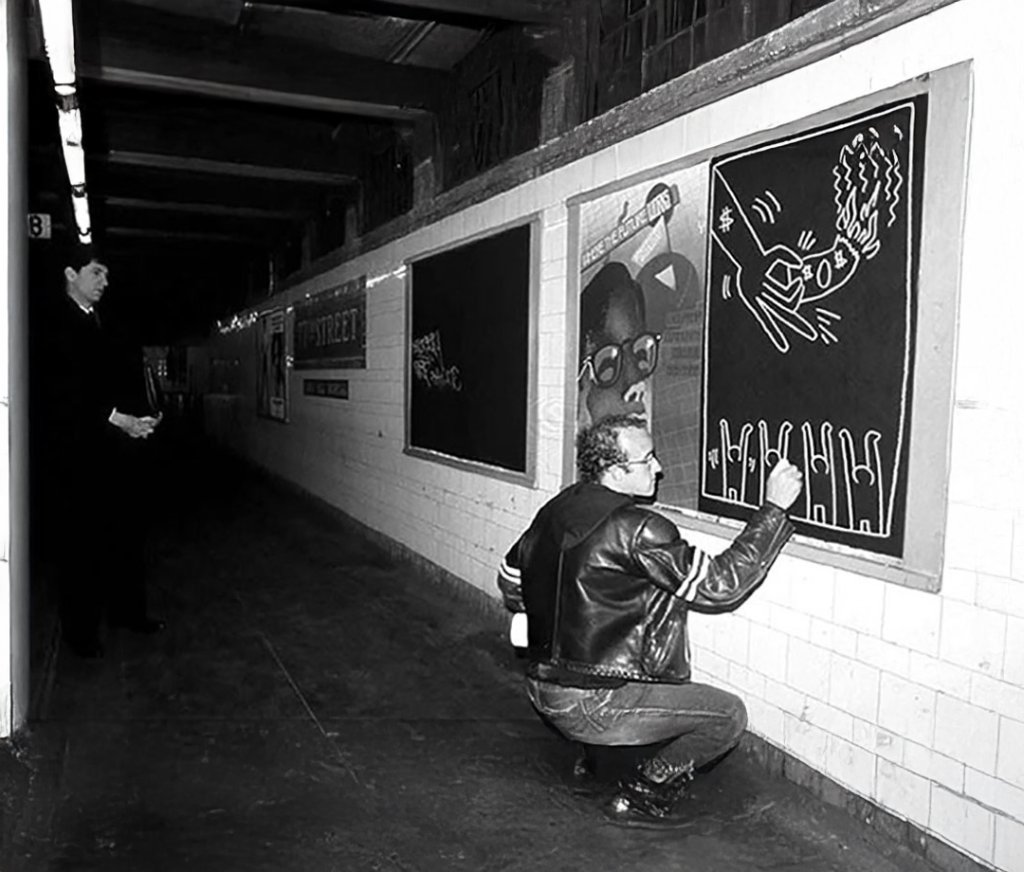
There's a reason Keith Haring comes up more than almost any other artist when collectors call me nervous. The market is flooded — reproductions, unauthorized prints, forged signatures, and wishful attributions circulate constantly on auction platforms, at estate sales, and at galleries that should know better. Haring died in 1990 at 31. His estate has been managing his legacy ever since, and every authenticated work sits within a finite ceiling while demand keeps climbing.
I've handled Haring across the full range of the market, from affordable Pop Shop multiples to major original works. What I want to show you here isn't theory. It's real documentation from two actual works I've handled — a 1989 screenprint from the Pop Shop series and an original ink on paper from a private collection. Neither is currently available, but both are unimpeachable examples of what airtight provenance looks like. Here's exactly why.
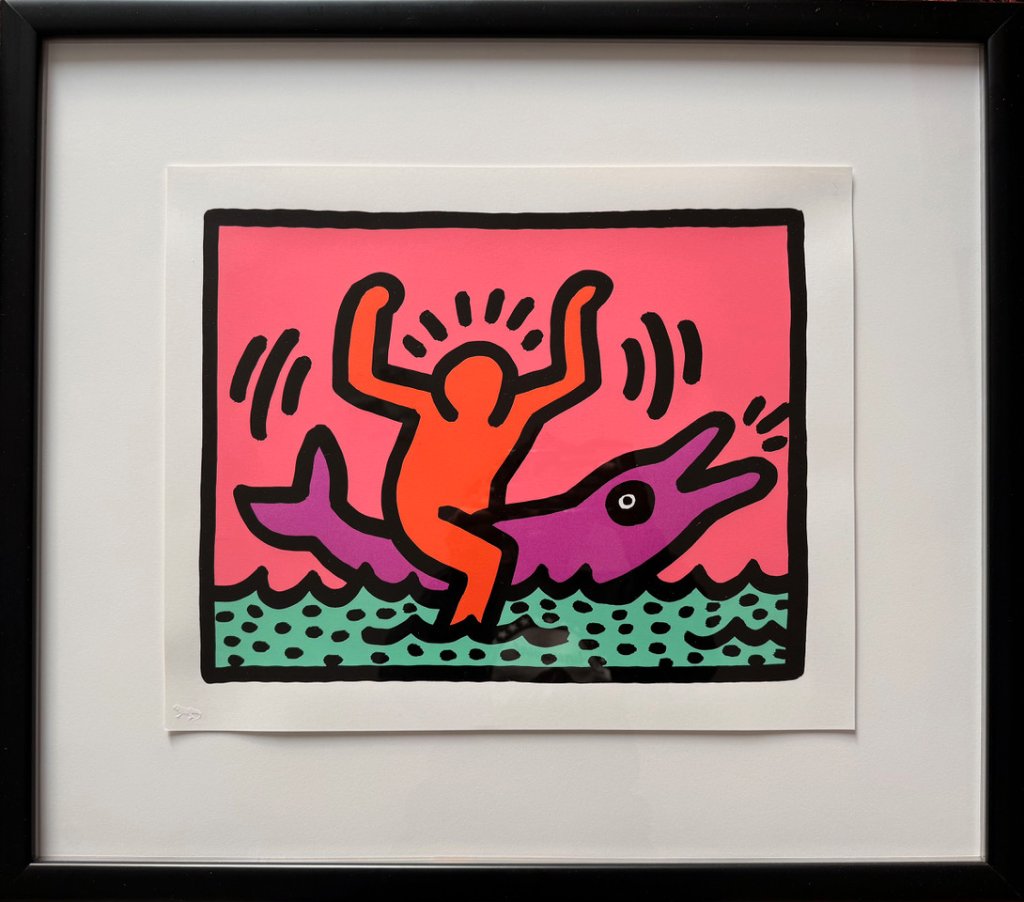
Keith Haring, Pop Shop V:B, 1989. Screenprint on paper, edition 95/200.
The paper trail: why the original invoice changes everything
Start with the purchase receipt. Not a gallery brochure. Not a label on the back of the frame. The original invoice from the selling institution.
This screenprint — a radiant figure riding a dolphin, rendered in Haring's signature hot pink, orange, and purple — was acquired from a private collector who originally purchased it through Martin Lawrence Limited Editions in January 1994. That original invoice has stayed with the work ever since. It is dated January 7, 1994, invoice number 1-066957. The title reads Pop Shop V:B, artist listed as Haring, edition number 95 out of 200. Catalog reference HAR 0590.
The price paid at the time of the original gallery sale: $1,087.50. That figure is now worth multiples of itself.
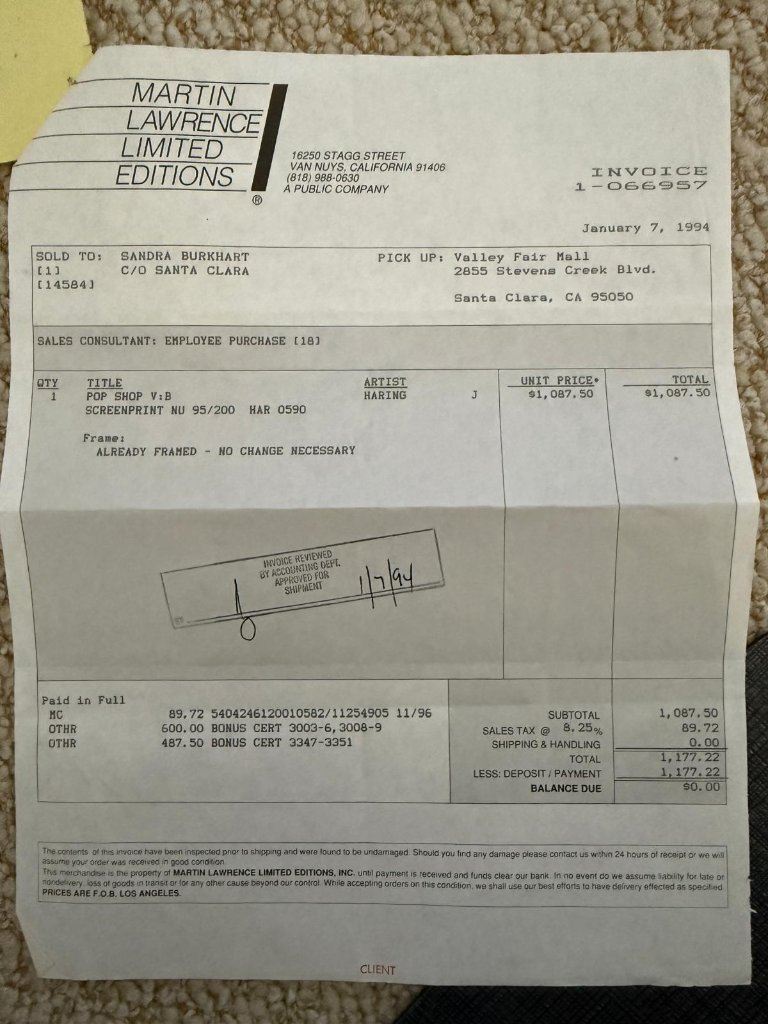
Original invoice #1-066957 from Martin Lawrence Limited Editions — dated January 7, 1994. Records the sale of Pop Shop V:B, screenprint, edition 95/200, at $1,087.50.
What makes this invoice valuable beyond the record of sale: it locks the edition number to a specific transaction at a specific publisher and anchors the work's chain of custody to a dateable moment. When you have a document like this, you've eliminated the two most common fraud scenarios in the Haring market — the unsigned open edition passed off as a numbered print, and the numbered print whose edition number doesn't match its estate documentation.
The Sumi ink on paper — and documentation that goes back to the studio
The second work is an original ink on paper. Large format — 70 × 85 cm — executed in 1987, professionally shadow-boxed. Haring's hand is unmistakable: the motion lines, the density of figures, the visual energy that fills the frame without losing breath.
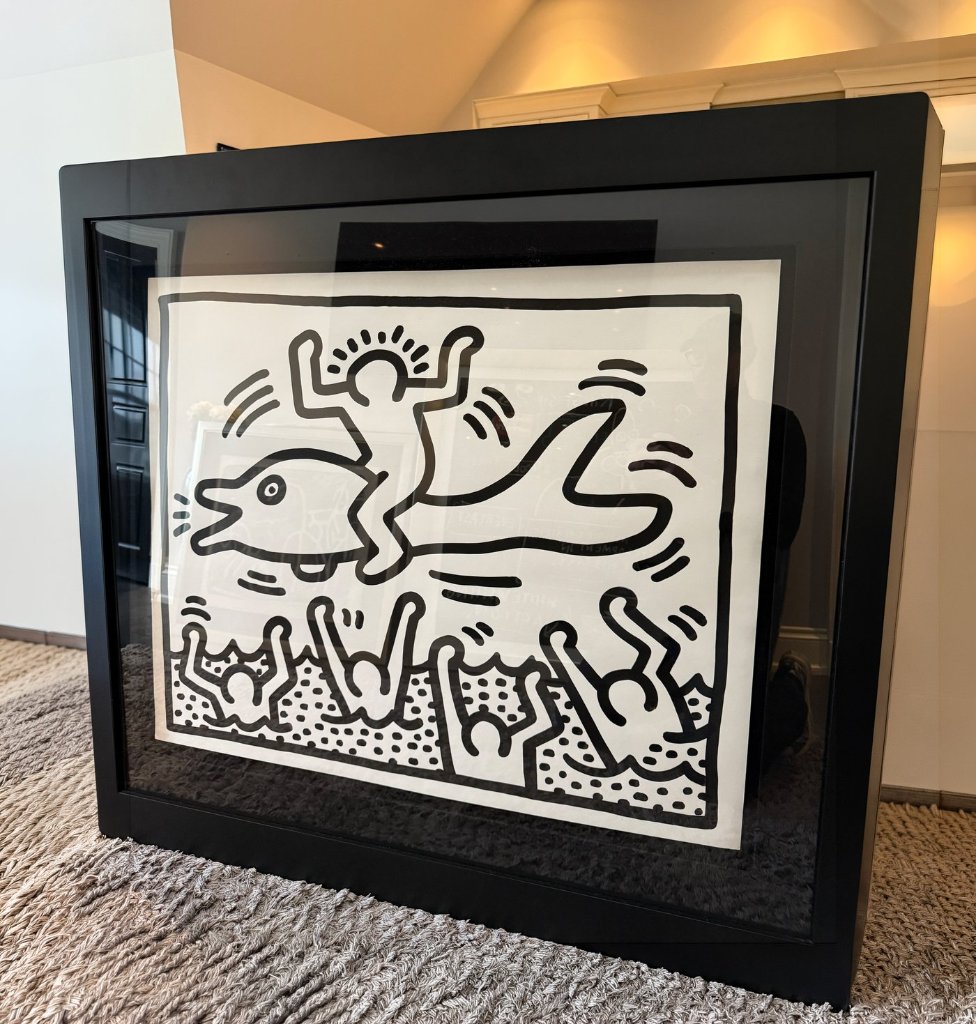
Keith Haring, Untitled, 1987. Ink on paper, 70 × 85 cm. Shadow-boxed. Private collection.
The Keith Haring Studio LLC issued an authentication letter for this piece on August 30, 2012 — bearing the studio's golden embossed seal and assigned Application Number 083012A1. The letter identifies the work as Untitled, dated June 7, 1987, ink on paper, 70 × 85 cm, and states plainly: "It is the opinion of the Studio at this time that the Work constitutes an authentic work of fine art by Keith Haring." It is signed by Julia Gruen, Executive Director of Keith Haring Studio LLC.
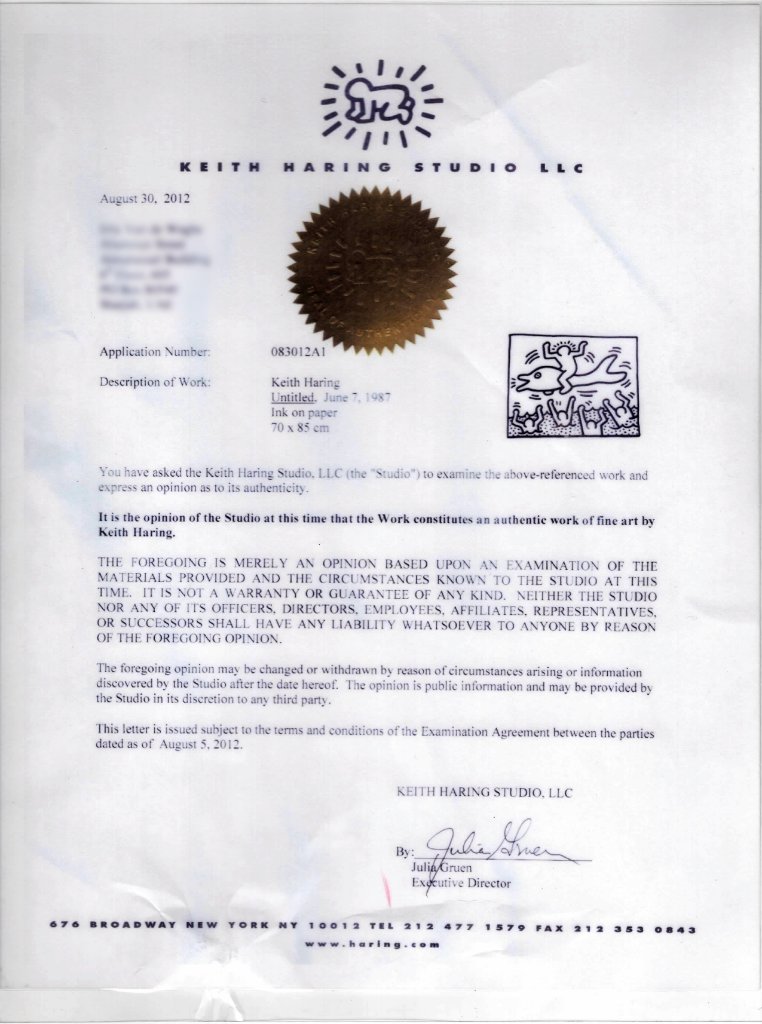
Keith Haring Studio LLC authentication letter, August 30, 2012. Application Number 083012A1. Bears the studio's golden embossed seal. Signed by Julia Gruen, Executive Director. Certifies Untitled, June 7, 1987, ink on paper, 70 × 85 cm.
The application number anchors the document
Application Number 083012A1 ties this authentication letter to a specific examination request filed with the studio. It means the work was physically presented and examined — this is not a letter issued on the basis of photographs alone.
The golden seal is a physical authentication mark
The embossed golden seal appears on legitimate Keith Haring Studio LLC letters from this period. Along with Julia Gruen's signature as Executive Director, it distinguishes genuine studio correspondence from unauthorized reproductions of the format.
Dimensions on the letter must match the physical work
The letter records 70 × 85 cm. The work in front of you should measure exactly that. A mismatch means either a wrong document has been paired with the work or something has happened in the chain of custody.
The examination agreement date matters
The letter notes it is "issued subject to the terms and conditions of the Examination Agreement between the parties dated as of August 5, 2012." Legitimate studio correspondence references it; forgeries typically don't.
The Polaroid that places the work at the moment of creation
Beyond the studio authentication, this piece carries something I rarely encounter: a Polaroid photograph made in Haring's studio on the day the work was created.
The photograph shows Haring at a work table, bent over a large sheet of paper, brush in hand. The studio around him is fully alive — mobiles hanging from the ceiling, objects on every surface, the compressed energy of a working artist mid-process. On the photograph, in pencil: K. Haring June 7 – 1987 © ®
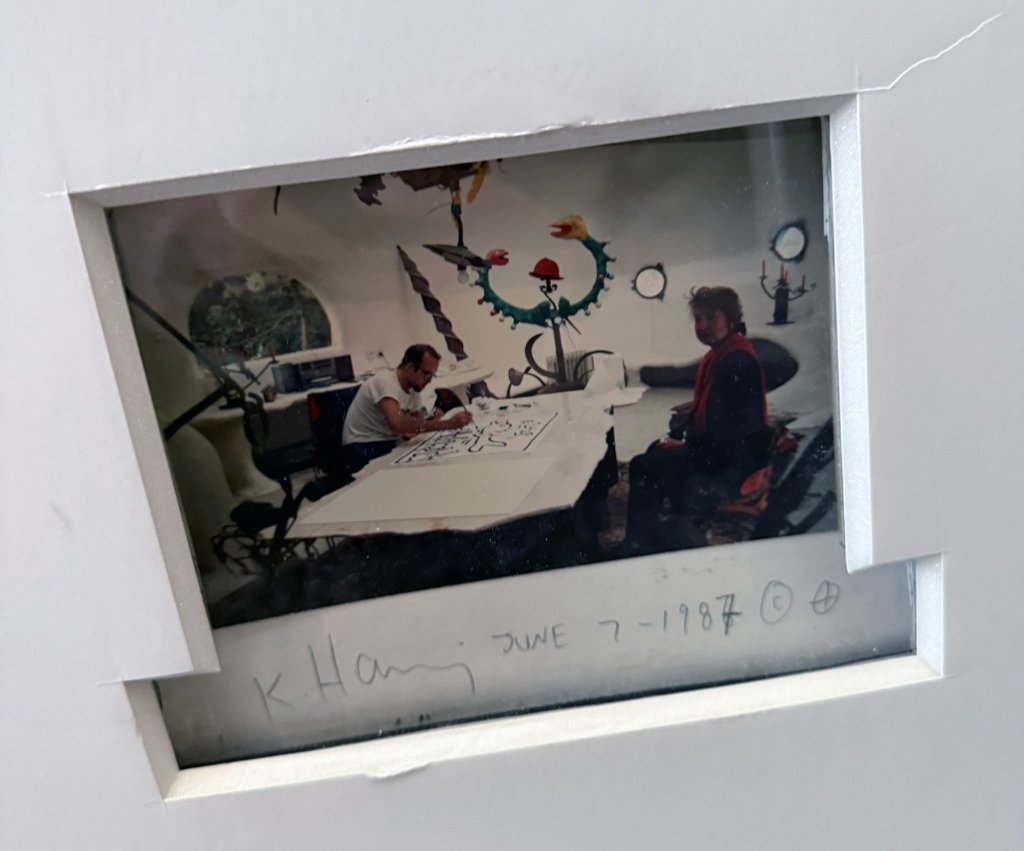
Studio Polaroid — Keith Haring at work, June 7, 1987. Signed in pencil: K. Haring June 7 – 1987 © ®. Primary-source provenance of this type — made at the moment of creation — is exceptionally rare in the secondary market.
"This is not a dealer's authentication after the fact. This is documentation made at the moment of creation — and that's a different category of evidence entirely."
Consider what that means. The Polaroid places a specific person in a specific studio on a specific date, actively working on a piece that corresponds to what you can see in front of you. A COA can be forged. A Polaroid in this condition — with a contemporary signature, bearing the physical characteristics of its period — is a primary source. It answers the origin question directly.
I've had my hands on a great number of Haring-attributed works. A studio photograph signed by the artist at the time of creation is among the rarest and most compelling forms of provenance I've encountered in this market. When buyers ask me what separates a strong Haring from a great one, this is the kind of answer I give.
What to watch for when you're buying Haring
Red flags
✕ Unsigned open editions marketed as numbered prints. Haring opened the Pop Shop in 1986 to make his work accessible. Those pieces are real and often wonderful — but none of them are the same as a numbered, estate-authenticated screenprint from a named publisher. Sellers conflate the two constantly.
✕ Signatures without a provenance chain. Haring signed prolifically — walls, shirts, subway panels, and paper. A signature alone, without documentation explaining where, when, and from whom the work was obtained, is not authentication.
✕ Late COAs on early works without supporting period records. A letter issued decades after the work was created, without supporting purchase records or examination documentation, warrants careful scrutiny.
✕ Vague "authorized" language without naming the institution, the edition size, and the publisher.
✕ Edition numbers that don't align across the print, invoice, and COA.
The standard worth holding to
The two works above define what strong Keith Haring provenance looks like in practice: an original 1994 gallery invoice from Martin Lawrence establishing the screenprint's first point of sale, and — for the ink on paper — a studio authentication letter from the Keith Haring Studio LLC bearing a golden seal and application number, supported by a studio Polaroid signed by the artist on the day the work was created.
Not every legitimate Haring will carry all of this. Works sold privately during his lifetime sometimes have thinner paper trails, and that's not automatically disqualifying. But thinner documentation raises the stakes on physical examination, condition, edition consistency, and the demonstrated credibility of the seller's sourcing chain.
The baseline test is simple: can you tell a clear, uninterrupted story of how this work got from Keith Haring's hands to yours? Every link in that chain matters.
If you're looking at a Haring and the story has gaps, bring it to someone who will tell you the truth before you write the check. The market is full of people who won't.
Looking at a Haring?
I work with collectors at every level of the market — from first purchases to significant acquisitions. If you're evaluating a work or looking for one, let's talk.
Get in Touch