Two weeks from now, New York has its biggest art week of the year. Last November, Christie's, Sotheby's and Phillips sold $2.2 billion across 18 sales and more than 1,700 lots. You'll read about the trophy paintings. You won't read much about the prints and works on paper that changed hands the same week in the day and online sales, at $5,000 to $50,000 a sheet. That's where my clients buy, and it's where the expensive mistakes get made, usually by smart people who did everything right except the arithmetic.
The dates that matter
- Previews open November 7. Sotheby's at the Breuer building, 945 Madison Avenue. Phillips at 432 Park Avenue. Christie's at Rockefeller Center.
- November 10: Bonhams Prints & Multiples, Los Angeles (more on this below)
- November 16: Sotheby's Now & Contemporary Evening Auction
- November 17: Christie's 20th Century Evening Sale
- November 18: Phillips Modern & Contemporary Art Evening Sale
- November 19: Christie's 21st Century Evening Sale
- Day sales follow the evenings at each house. That's where the editions and works on paper live.
Previews are free and open to the public. Go. Nothing replaces standing a foot from the sheet.
The hammer is not the price
Every major house raised its fees in the last fourteen months, and the rates now sit almost level:
| House (New York) | Buyer's premium on a print-level lot |
|---|---|
| Christie's | 28% up to $2M (since September 1, 2026) |
| Sotheby's | 28% up to $2M (since February 13, 2026) |
| Phillips | 29% standard, 25% with a Priority Bid |
| Bonhams | 30% on the first $35,000 (since October 1, 2026) |
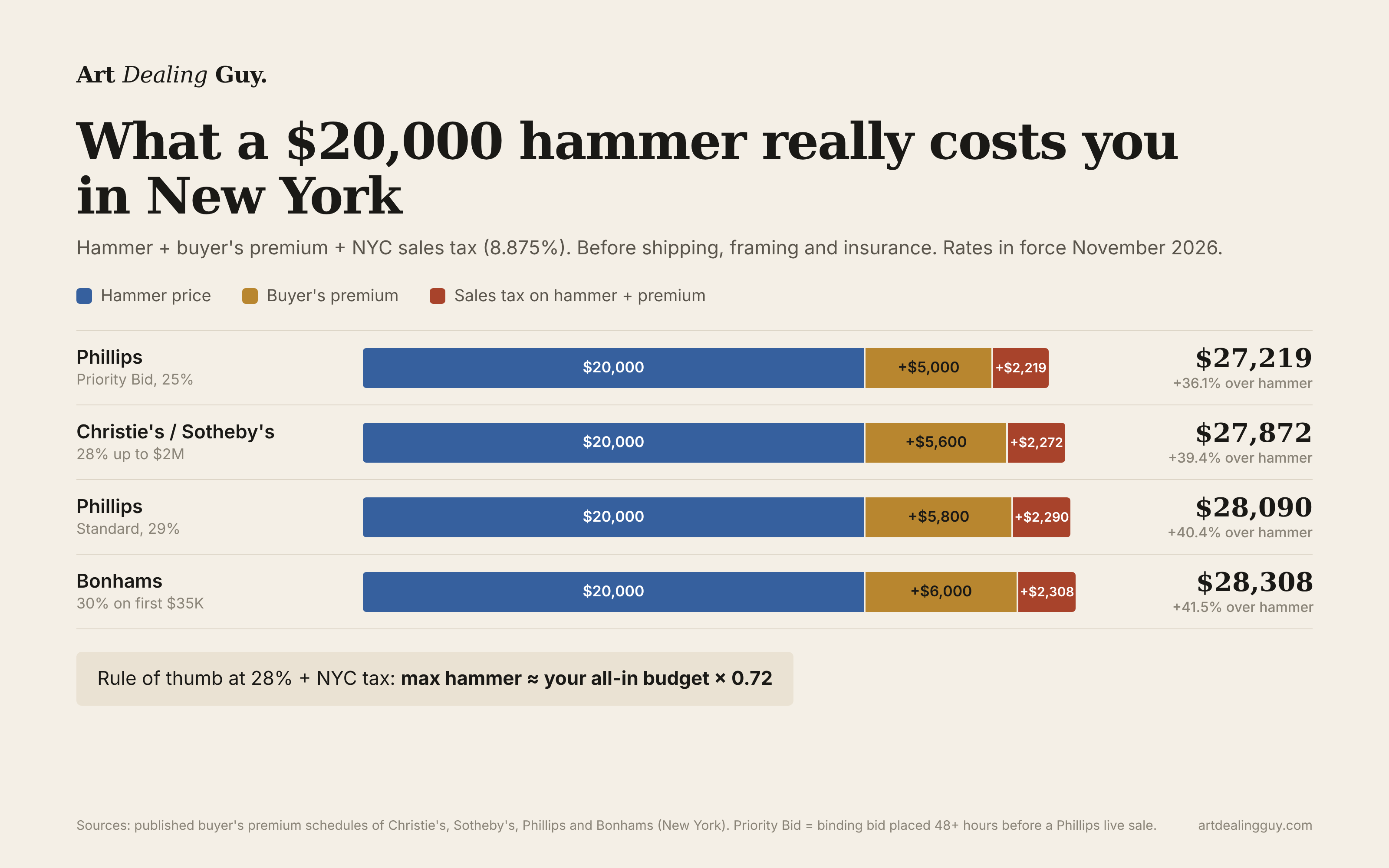
Then comes sales tax. Take delivery in New York City and you pay 8.875% on the hammer and the premium. Here's what that does to a $20,000 hammer:
| Christie's / Sotheby's | Phillips (standard) | Phillips (Priority Bid) | Bonhams | |
|---|---|---|---|---|
| Hammer | $20,000 | $20,000 | $20,000 | $20,000 |
| Buyer's premium | $5,600 | $5,800 | $5,000 | $6,000 |
| NYC sales tax | $2,272 | $2,290 | $2,219 | $2,308 |
| You pay | $27,872 | $28,090 | $27,219 | $28,308 |
That's before shipping, framing and insurance. A $20,000 print at Christie's or Sotheby's is a $27,872 print.
Run it backwards
The useful number isn't what you'll pay. It's where you stop. At 28% plus New York tax, multiply your all-in budget by 0.72 and that's your last bid. A $25,000 budget means you stop at about $17,900 on the hammer. Write that number in the margin of the catalogue before you walk in. Then don't move it.
Shipping the work out of state usually takes New York's tax off the invoice. That isn't a loophole. Most states expect you to pay use tax at home, so ask your accountant before you count it as savings.
The one discount almost nobody uses
Phillips runs something called Priority Bidding. Place a written bid at least 48 hours before a live auction starts and, if you win, your premium drops from 29% to 25%. It applies to the full hammer, even if you end up bidding higher in the room. On a $20,000 hammer that's $800 in premium and about $870 once tax is counted.
The catch is the reason it works: a Priority Bid is binding. You can't cancel it or lower it. It doesn't apply to timed online-only sales. So it's only a discount if your diligence is already finished. If you're still deciding, it's a commitment you haven't earned yet.
Read the condition report like a seller wrote it
Auction lots are sold as is. Christie's provides condition reports free. Sotheby's provides them, in its own words, "solely as a convenience." Either way, the report is written by the side that wants the lot to sell.
When I read one for a client, I'm looking for what's missing as much as what's there:
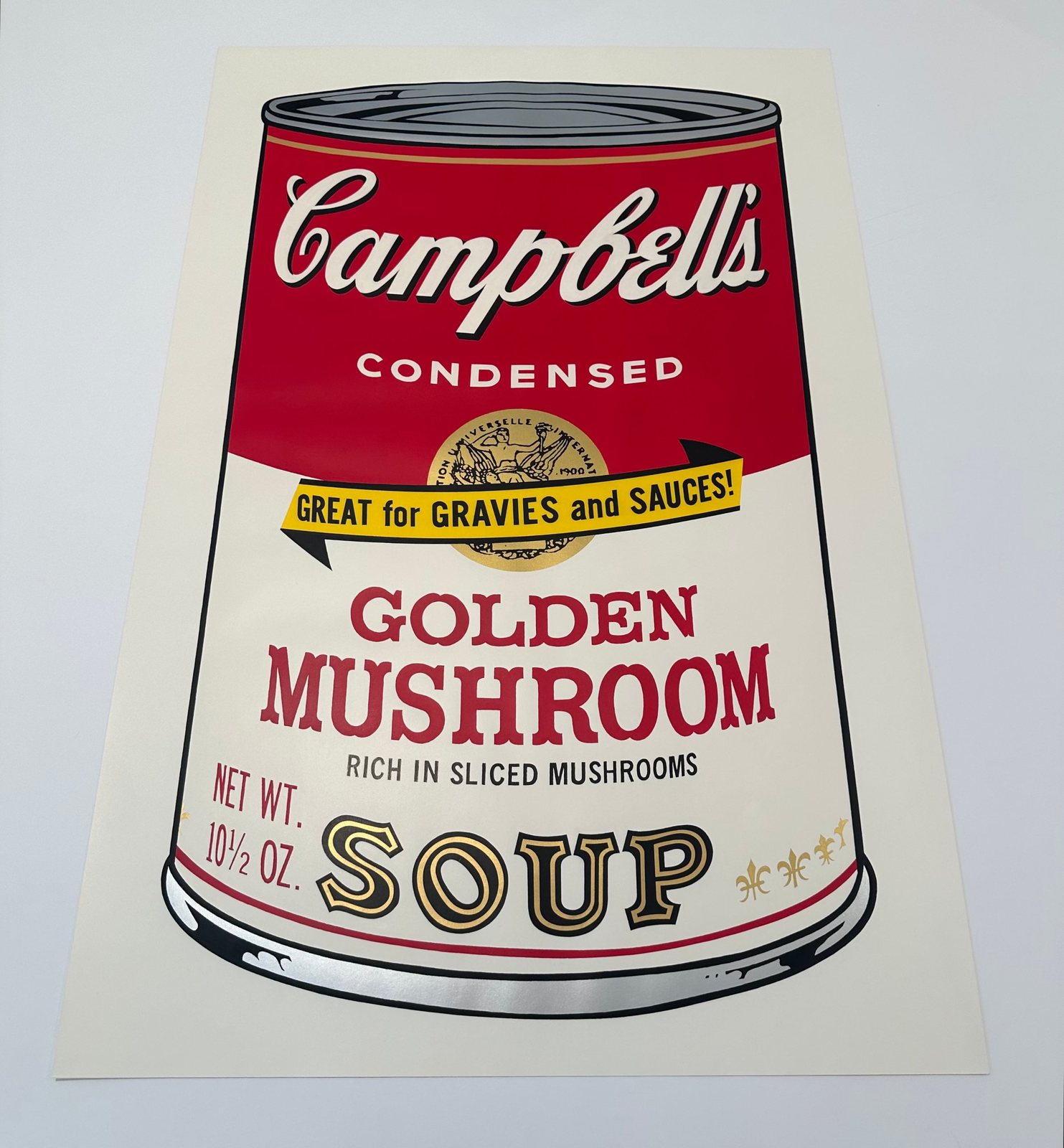
- Where the signature should be. Not every print is signed on the front. Warhol's Campbell's Soup II sheets are signed in ballpoint pen on the back and numbered with a rubber stamp. A listing that only shows you the front of one of these has skipped the two details that matter most.
- The verso. Hinges, tape, old mounts, glue. A sheet that was laid down to board has lost value, and the front won't tell you.
- Light. Toning, mat burn, faded colours. Ask whether UV images exist. If they do, ask for them.
- Margins. Trimmed sheets are worth less, and trimming is easy to miss in a frame.
- The paperwork against the sheet. Edition number, signature placement and catalogue raisonné reference should all match the image you're looking at.
A report that says "appears in good condition" and nothing else is not a clean bill of health. It's a report nobody wrote.
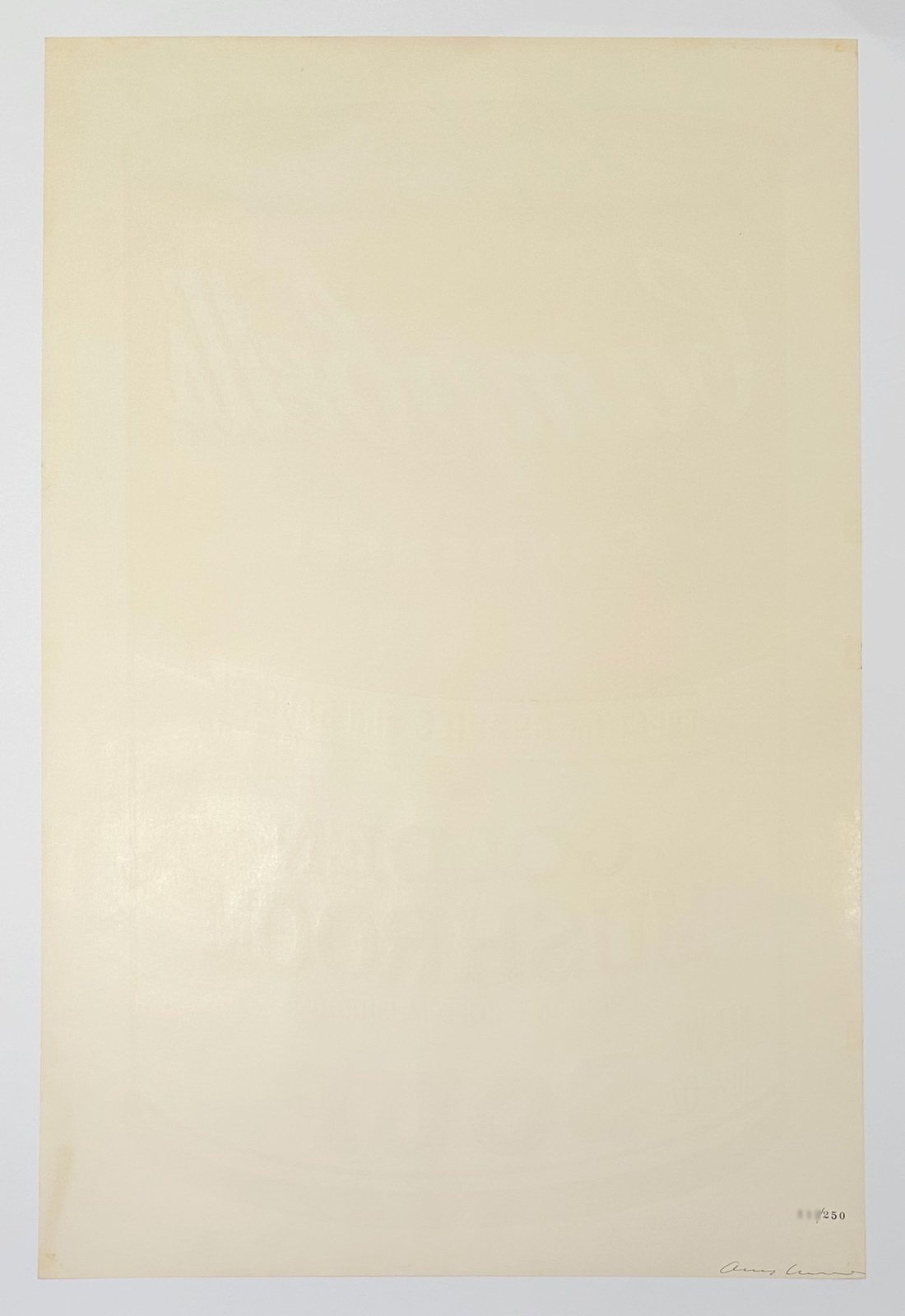
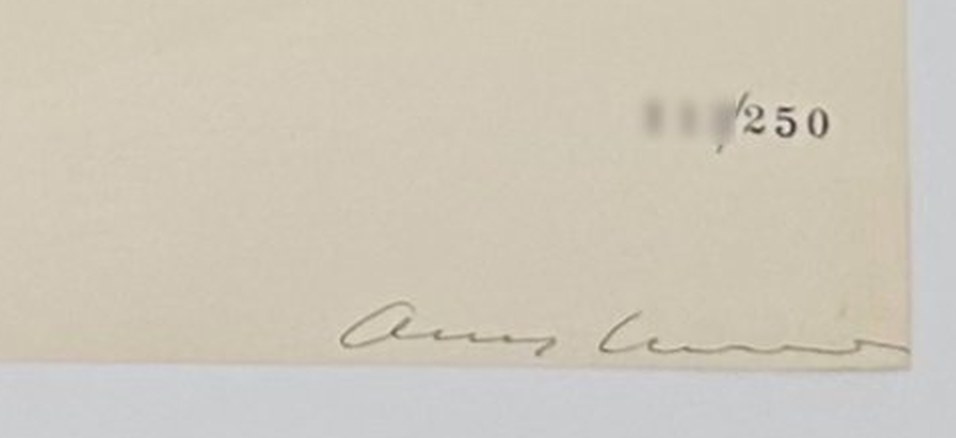
The back of the same sheet: signed in ballpoint pen and stamp-numbered from the edition of 250, exactly where the catalogue raisonné says they should be (number blurred to protect the owner). Unmounted, with no hinges or tape. This is the photo I ask for first.
One lot to watch, and it isn't in New York
Not every print worth bidding on sells during marquee week. Bonhams holds a Prints & Multiples sale in Los Angeles on November 10, with viewing November 6 to 9. Its headline lot is Roy Lichtenstein's Forms in Space, estimated at $50,000 to $70,000.
The facts first. Forms in Space (Corlett 217) is a 1985 screenprint on Rives BFK, published in an edition of 125 plus 20 artist's proofs for the Institute of Contemporary Art in Philadelphia and printed by Studio Heinrici in New York. It has come to auction roughly 30 times since 2005, and between 2020 and 2024 hammer prices ran from about £49,000 to £132,000. That spread is the lesson: same image, same edition, and a price that swings with the condition of the impression and who shows up on the day.
Here's the invoice at Bonhams' new rates (30% on the first $35,000, 28% above it):
| Low estimate | High estimate | |
|---|---|---|
| Hammer | $50,000 | $70,000 |
| Buyer's premium | $14,700 | $20,300 |
| Before tax and shipping | $64,700 | $90,300 |
Then sales tax, which follows the delivery address, not the saleroom. Collect it in Los Angeles and you pay California tax on the whole amount, around 10%. Ship it home to New York or New Jersey and your own state's tax applies instead. There's no early-bid discount at this sale, so the premium is the premium.
Before I'd let a client bid on this, I'd want three things: a condition report that describes the back of the sheet (big sheets get handled, and handling shows), the edition number checked against recent results, and a look at whether another impression is available privately. With an image that trades this often, there frequently is.
When to skip the saleroom
Auction isn't automatically the expensive route. In a thin day sale, a prepared bidder can buy below what dealers are asking. The point is knowing which situation you're in before the lot comes up.
Bid when: the image is common, there are plenty of recent comps, the condition report is complete, you've seen the sheet in person, and the estimate sits under private-market asking prices.
Buy privately when: it's a rare colourway or proof and you can't afford to lose it to one stubborn underbidder; you want the price fixed before you commit, with nothing stacked on top; you need time to inspect; or the lot has already gone unsold, which often means it can be negotiated quietly after the sale. (More on that in How to Buy Art From a Private Dealer.)
PRICE THE WHOLE INVOICE.
In New York, 28% plus tax adds roughly 39% to the hammer. Budget for that, not the estimate.
YOUR CEILING IS 0.72.
All-in budget times 0.72 is your last bid. Decide it before the sale, not during.
BID EARLY AT PHILLIPS, ONLY IF YOU'RE SURE.
A Priority Bid saves four points of premium. It's also binding.
READ THE REPORT FOR WHAT ISN'T THERE.
Ask for the verso and the UV. Silence in a condition report is not good news.
What this doesn't mean
It doesn't mean you should avoid auctions. Public sales are the most transparent price discovery this market has, and some of my clients' best buys came out of day sales. It doesn't mean dealers are always cheaper either. It means the saleroom rewards preparation and punishes enthusiasm, and the people who do well there decided their number before the auctioneer did.
"The auctioneer calls the hammer. The invoice calls the price."
Quick answers
What is the buyer's premium at Christie's and Sotheby's in 2026?
Both charge 28% of the hammer price up to $2 million in New York, with lower rates above that.
What is Phillips Priority Bidding?
A binding written bid placed at least 48 hours before a Phillips live auction. If it wins, the buyer's premium is 25% instead of the standard 29%.
How do I work out my maximum bid?
At a 28% premium with New York City sales tax, multiply your total budget by 0.72. Adjust for the house and your delivery state.
Watching a lot this November?
Send me the sale and the lot number. Before you register a bid, I'll pull the comps, read the condition report with you, give you your real all-in number, and tell you honestly whether I can find the same image privately for less. If I can't, I'll tell you to bid. If you'd rather not sit on the phone yourself, I can place and manage the bid for you, on terms we agree up front. The review costs you nothing. Get lots to me by November 12 for the New York sales, or by November 6 for the Bonhams Los Angeles sale on November 10.
GET IN TOUCH →Read next: The Rebound Is Real. It's Also Narrow. · Buying a Warhol Print, What You Actually Need to Know